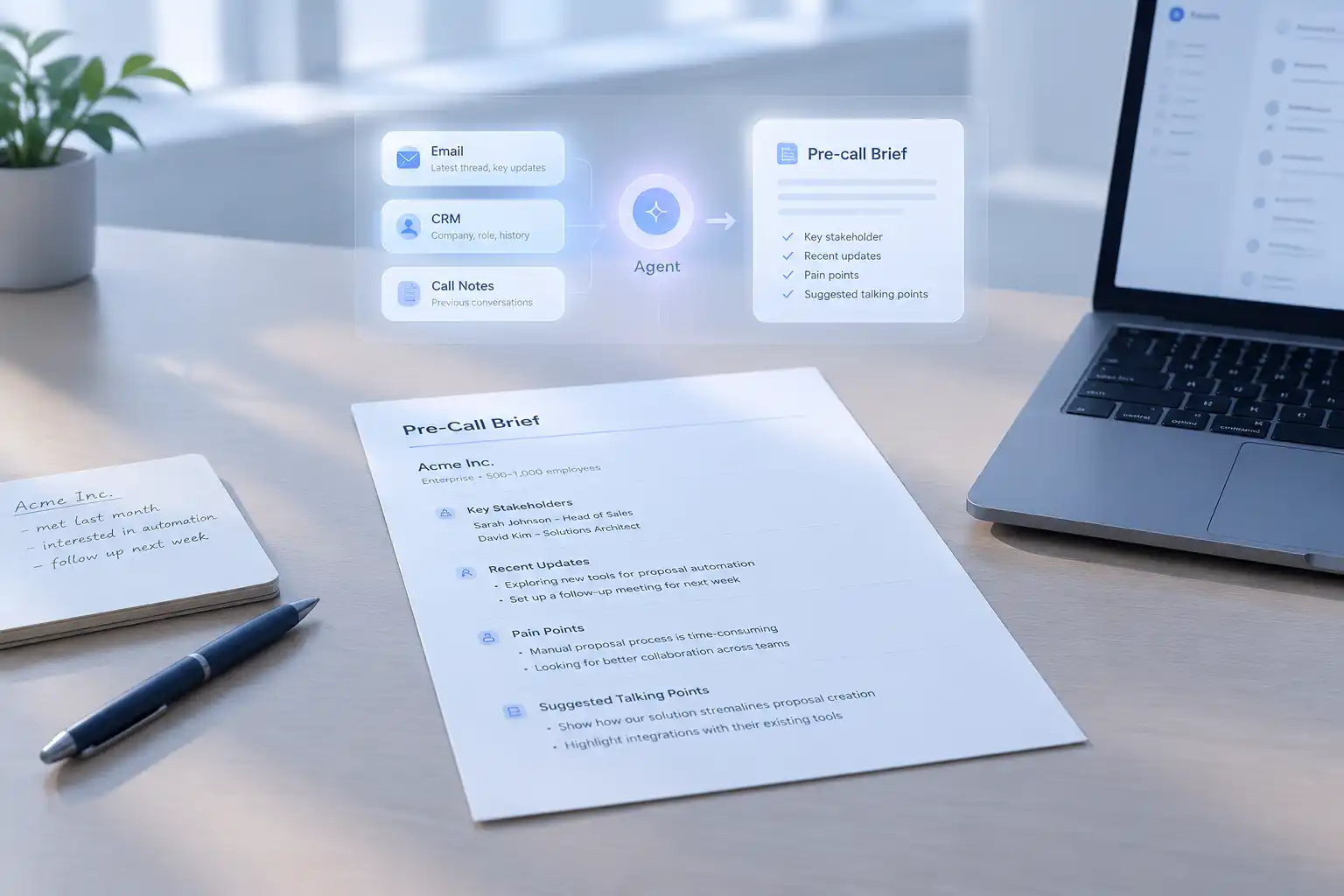
A solutions engineer can spend a Monday morning on three versions of the same job. One account needs a pre-call brief. Another is waiting for notes and requirements from yesterday's workshop. A third has a solution review on Thursday, and someone has already asked whether the platform can handle a requirement that nobody has checked against the product.
Each task differs in content and matches the others in method. Most teams add an AI tool to each task. The documents get faster, the process does not change, and the same gaps reappear on the next deal.
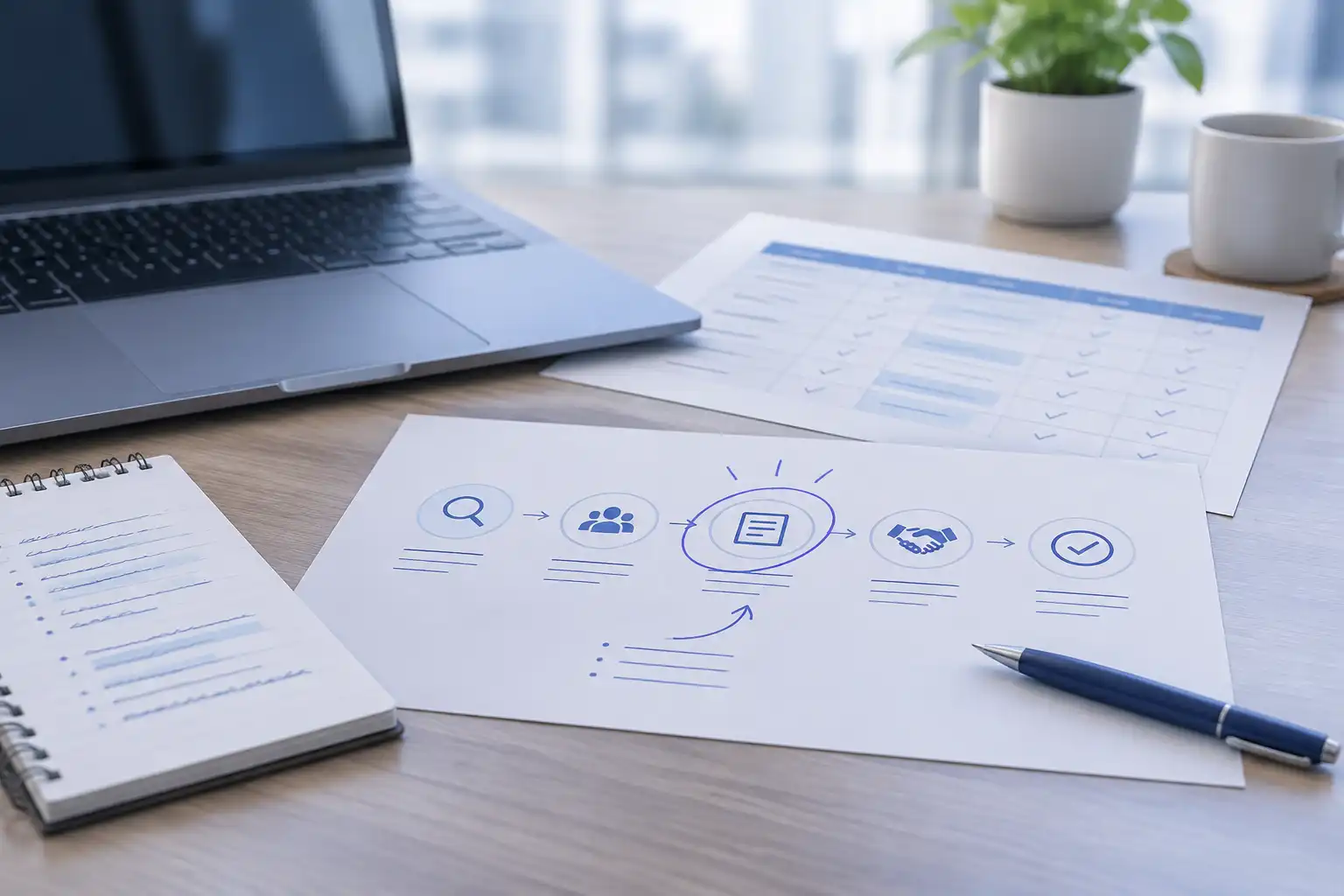
This guide treats automating the presales process as one workflow from customer preparation to proposal. It covers what to automate, how to design handoffs, how to train and validate an agent on real deal material, and where a person decides.
What Is Presales Workflow Automation?
Presales workflow automation means designing the repeatable path from account research to a reviewed proposal, then letting AI handle the parts that follow a stable pattern. The unit is a stage with a defined input, output, and review point, not an individual document.
Three levels of automation fail in different ways.
| Level | What gets automated | Does it survive a new account? | Example |
|---|---|---|---|
| Task | One piece of writing or analysis | No, it starts fresh each time | Draft a follow-up email |
| Stage | A fixed method for one deliverable | Yes, the structure carries over | Produce the same notes and requirement format after every workshop |
| Process | The handoffs and facts between stages | Yes, and context accumulates | Workshop findings feed the solution matrix and the proposal |
Task-level shortcuts save minutes. Stage-level standards make one part of the job predictable. Process-level design changes how a team works, because each stage receives something usable from the one before it.
Presales suits this approach: inputs arrive as text, stage boundaries are easy to describe, rework is expensive when a missed constraint surfaces after a proposal, and work passes between people often.
This workflow is AI-assisted, not fully automated. AI prepares, extracts, drafts, and checks; a person reviews each stage and decides. A fully automated workflow would run stages without human checkpoints, which does not fit customer commitments, pricing, architecture choices, or relationship decisions.
For a broader definition, see what workflow automation includes.
Which Presales Tasks Can AI Automate?
AI for presales is most useful when a task repeats often, its inputs are text or structured information, and an experienced person can judge the output quickly. If one condition is missing, supervision usually costs more than the task saves.
| Presales stage | Task | Suggested mode | What AI needs | What a person must check |
|---|---|---|---|---|
| Account and role research | Company background, org structure, technology clues | Draft | Public material, past records | Whether facts are current and guesses are labeled |
| Call preparation | Brief, agenda, question set, hypotheses | Draft | Account context, product boundaries | Whether the questions fit this account |
| Meeting notes and requirements | Notes, requirements, constraints, decision makers | Draft and extract | Recording or notes, existing documents | Whether customer wording, inference, and open items stay separate |
| Solution assessment | Requirement matrix, capability comparison, gap list, draft delivery risks | Draft | Requirements, documented product capabilities | Whether the fit is real and the delivery timeline is feasible |
| Demo | Script and scenario order | Draft | Prioritized requirements | Whether each scenario matches something the customer said |
| POC | Scope, success criteria, data checklist | Draft | Requirement matrix, risk list | Whether the scope stays inside what the team can deliver |
| RFP and questionnaires | Classification, first draft, consistency check | Semi-automated | Answer library, product documentation | Compliance wording and numbers |
| SOW and proposal | Scope, assumptions, risks, executive summary | Draft | Outputs from earlier stages | Commercial terms, price, legal wording |
The table hides a distinction in solution assessment. AI can organize requirements, compare them against documented capabilities, list gaps, and draft delivery risks. It cannot confirm that a feature will work in the customer's environment, that an integration effort is realistic, or that a delivery date is achievable. Those judgments depend on architecture, resources, and commitments outside the document.
The human role is specific: validate technical fit, verify delivery feasibility with the people doing the work, and decide what the team promises. AI prepares the evidence. It does not make the call.
Pricing, discounts, delivery commitments, final architecture choices, relationship decisions, and external security statements stay human-led. A useful rule: if a wrong statement creates a company obligation, a person decides it; if one revision can fix it, AI goes first.
Existing guides cover discovery call preparation, demo scripts, fast POC builds, and RFP responses. For tool selection across these stages, see AI tools for solutions engineers.
How to Build a Reusable AI Workflow for Presales
A reusable workflow has four parts. Each produces something a teammate can use without explanation.
Customer Context
Keep one record per account: background, key roles, confirmed requirements, constraints, decision criteria, and open questions. Keep confirmed facts and open items in separate sections, and note where each came from.
The rule that matters most: if the customer did not say it, it does not enter the confirmed section. A competitor mentioned on a call is a data point, not a requirement. A guess about budget is a hypothesis until the buyer confirms it.
The output is an account profile short enough to read before a call and structured enough to update after one.
Stage Inputs and Outputs
Define two things for every stage: what must be available before it starts, and what counts as finished. A meeting stage might require the agenda and the recording, and always output customer quotes, requirements, constraints, open questions, and next steps. A solution assessment stage might require confirmed requirements and documented capabilities, and always output a requirement matrix, a fit conclusion per requirement, a gap list, and delivery risks with their assumptions.
Without a fixed format, every stage produces a different document and the next person starts by reformatting.
Handoffs
A handoff works when the next stage can start from the previous output without a conversation. Ask the next person one question: can you begin?
If the answer is no, add a field rather than a paragraph. A matrix that cannot be traced to a customer statement is not ready for assessment. A risk without an owner or dependency is not ready for a proposal.
Review Checkpoints
Put a fixed checklist at the end of each stage. Four items cover most presales work:
- Does every fact have a source?
- Are missing items marked as open rather than filled in?
- Does each fit conclusion cite a documented capability?
- Is each delivery risk tied to a specific capability, resource, or timeline gap?
The checkpoint also records which stage produced a claim and who reviewed it.
Once the stages are mapped, look at the chain. Two problems usually appear: a stage produces something nobody uses, or a stage needs information no earlier stage collects. Both matter more than the choice of AI tool.
Start with a stage that repeats weekly and has a stable structure, such as meeting notes. The criteria are covered in how to identify workflows worth automating. When the output is stable, save it as a reusable capability, which is what an AI Skill represents.
How to Train and Validate an AI Agent for Presales Work
Designing the workflow is one job. Getting an agent to follow it reliably is another. The general method for training an agent on a workflow is covered in a separate guide. This section focuses on what AI for sales engineering demands and how to prove the agent has learned it.
Teach from finished work. Give the agent two real deliverables: one that reached a customer without heavy edits, and one that was substantially rewritten. Explain what changed and why. Examples teach judgment in a way a list of steps cannot.
Teach the behavior for uncertainty. Presales output fails when a draft sounds more certain than the evidence allows. Set explicit rules: customer statements need a source, missing data is marked open, and capability claims point to documented material.
Teach judgment with past cases. When should the agent suggest a narrower POC? When should it flag that a requirement sits outside the current product? These calls are easier to learn from two or three closed deals than from adjectives such as "conservative" or "accurate."
Validate on a closed deal whose outcome you know. Give the agent the original notes, emails, and documents, then ask for requirements, source references, capability gaps, and delivery risks. Compare with what the team found. Score substance, not formatting.
| Check | Pass condition |
|---|---|
| Requirement extraction | Captures the requirements the team captured, without adding new ones |
| Source trace | Each requirement points to a specific note, email, or document |
| Gap identification | Flags the same capability gaps the team identified, and does not invent fit |
| Delivery risk | Surfaces the constraints that affected the real delivery, with specific causes |
| Uncertainty handling | Marks missing information as open instead of filling it in |
A polished document that misses a gap has failed. A rough draft that catches a missed risk has done the job.
When the agent passes, hand the result to the team. Save the repeatable method as a Skill, keep account facts in the project context, and combine related capabilities into a Plugin so the setup can be reused. The review questions in AI permission management apply here.
Practical Example: From Customer Discovery to Proposal
The company and people in this example are fictional and used for illustration only. Vantage Logistics, Priya, Dana, and Tom do not represent a real customer, a real deployment, or a real outcome.
Vantage Logistics is a regional freight operator replacing a homegrown shipment tracking spreadsheet. Priya is the solutions engineer. Dana runs operations, Tom owns IT security, and the platform is being evaluated for a first-quarter launch before peak season.
Call preparation. Priya starts with the account record and public material. The agent produces a one-page brief, a few hypotheses, and a question list. She checks that industry assumptions are labeled; the output is a question set, not conclusions.
Meeting notes and requirements. After the workshop, the agent turns the recording into notes with decisions, open items, and next steps. It extracts requirements, constraints, and decision owners. Priya checks that customer wording, inference, and unanswered questions remain separate. Confirmed items update the account record.
Solution assessment. The agent builds a requirement matrix: requirement, documented capability, fit status, and gap. It drafts risks for items that depend on data quality, integration work, or the customer's internal team. Priya validates fit with product and feasibility with delivery. She removes one risk the agent overstated and adds one it missed: the security review may outlast the launch window.
POC. The scope comes from the matrix and the risk list. It covers the requirements with the highest uncertainty, not every demo feature. The agent drafts success criteria and a data checklist. Priya checks that the scope fits the customer's integration capacity.
Proposal. The agent drafts the executive summary, scope, assumptions, dependencies, risks, and implementation plan from earlier outputs. Priya reviews commercial terms with the account executive and legal wording with the team. The security review appears as a dependency, not an internal note.
| Stage | Inherits | Records | Passes on |
|---|---|---|---|
| Call preparation | Account history, public material | Industry context, org clues, hypotheses | Question set |
| Meeting notes | Questions and answers | Customer quotes, decision makers, constraints, open items | Requirement list, role map |
| Solution assessment | Requirements and constraints | Fit conclusions, gaps, delivery risks | Requirement matrix, risk list |
| POC | Matrix and risks | Success criteria, data conditions | Scope and acceptance criteria |
| Proposal | All confirmed facts and risks | Commercial boundaries | A reviewable proposal |
The next account reuses the structure and replaces the facts. That is the difference between a workflow and a folder of documents.
For the proposal stage, proposal management software covers tools that store and route content, while executive summary guidance covers the writing.
Best Practices and Human Review
Surface Delivery Risk Early
AI makes it easy to write a smoother proposal. The value often comes from saying where the smooth version is wrong: a capability gap, an integration estimate nobody scoped, or a timeline that ignores a security review.
Require a "risks and assumptions" section in every assessment and proposal. Each entry names a specific cause and dependency. "Some risk may exist" is not a risk. "Single sign-on depends on the customer's identity team, available in week six" is one.
Set Review Gates
Four categories always need a person: numbers and dates, external commitments, customer quotes, and security statements. A claim without a source is marked open, not softened.
Keep the Engineer's Voice
Use AI for the first draft and rewrite the parts a customer will remember. Buyers notice template language when they ask follow-ups. Keep one or two judgments only you can make; trust comes from there.
Measure the Process, Not the Tool
Track cycle time, reworks, reuse of a stage output on a later account, and the share of first drafts that survive review. Writing time alone is easy to improve and says little about deal quality.
Common Mistakes
- Automating documents while leaving the process unchanged.
- Using one large prompt for every stage, which makes failures impossible to locate.
- Letting the account record go stale.
- Carrying facts from one customer into another customer's material.
- Producing a polished proposal with no delivery risk section.
How Noumi Fits
Noumi is an AI workspace for solutions engineers and business analysts. Four capabilities map to the workflow above.
Connectors, MCP, and CLI connect the tools and sources a team already uses. The available range depends on supported connections and configuration, so check the systems your team needs.
Skills save a repeatable method, such as the structure of meeting notes or a solution assessment, so the next task starts from the same standard.
Learning Items hold working requirements and project facts. When a constraint changes, you update the record instead of repeating the background in every prompt.
Plugins combine related capabilities into a single setup, so the same combination can be used again.
These capabilities manage the process and the facts. Pricing, commitments, and final solution choices remain with the engineer and the deal team.
Start With the Meeting You Already Ran
Pick one stage you repeat weekly. Define its input, output, and four review checks. Run it on your last customer meeting, then compare the output with what you would have written.
If the draft captures the requirements, traces them to a source, names the gaps, and surfaces a delivery risk, you have something worth reusing. If it only reads well, fix the standard before you automate the next stage.
Explore Noumi's use cases for discovery, requirements, and solution preparation.