
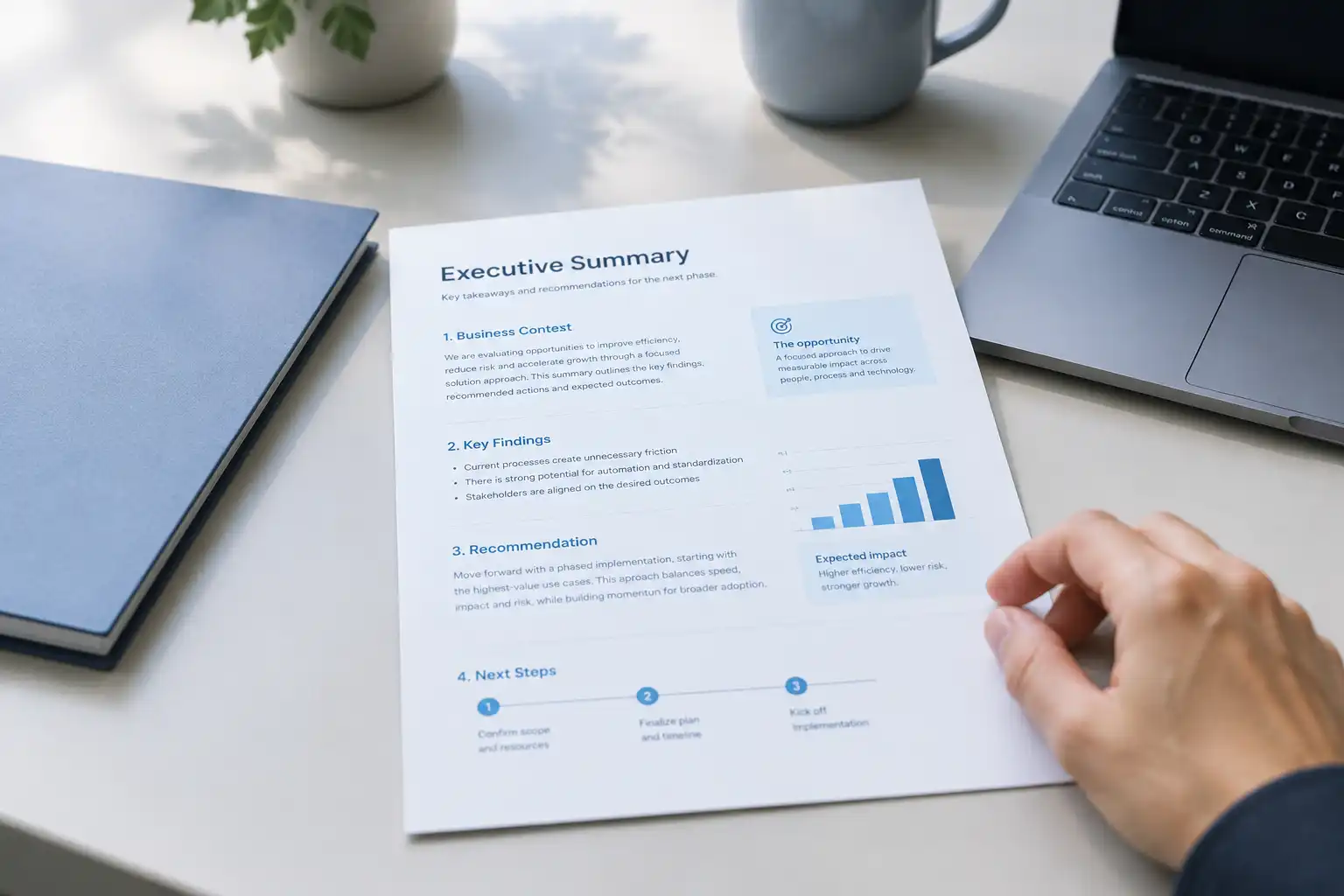
Proposal managers, solutions engineers, and presales teams often write the business proposal executive summary last, under deadline pressure, by trimming the document they have just finished. The result reads like a table of contents with adjectives: it describes the proposal instead of helping the buyer decide.
That matters because the summary is often the only section a senior buyer reads in full. A vice president may scan it, forward it, or use it to compare three vendors before anyone opens the technical volume. If the recommendation, evidence, and commercial terms are not clear on that first page, the rest of the proposal may never get a fair reading.
This guide covers what a business proposal executive summary needs to do, a five-step process, a reusable template, and two worked examples for different buying processes.
What Is a Business Proposal Executive Summary?
A business proposal executive summary is a short opening section that states the client's situation, your recommended solution, the evidence behind it, the commercial headline, and the decision you are asking for. It sits before the table of contents and is written to be read on its own.
It is not a shortened version of the whole proposal. A proposal argues every requirement, explains delivery, and answers contractual questions. The summary selects the few facts that determine whether the buyer should continue.
It differs from an introduction, which sets up the document; a cover letter, which is correspondence; and an abstract, which describes what follows. A summary delivers the conclusion and recommends a decision.
A useful test: if the summary were forwarded to a colleague who never sees the proposal, would that person understand the problem, recommendation, cost, and next step? If not, it is still a description.
What to Include in a Business Proposal Executive Summary
| Element | Question it answers | Typical space |
|---|---|---|
| Decision and reader | Who must approve what, and by when? | 1–2 sentences |
| Client situation | What is happening, and what does it cost them? | 2–4 sentences |
| Recommendation | What are you proposing, and why does it fit? | 3–5 sentences |
| Evidence | Why should the buyer believe it will work? | 2–3 sentences |
| Commercial summary | What does it cost, how long will it take, and what is assumed? | 2–4 sentences |
| Next step | What happens after approval? | 1–2 sentences |
The order can change. Some proposals lead with the decision, others with the client's situation. What cannot change is that all six questions are answered somewhere on the first page.
How to Write a Business Proposal Executive Summary in Five Steps
Step 1: Define the decision and the reader
Start with the decision, not the document. Write one sentence: "[Role] needs to approve [scope] so that [outcome] by [date]." This forces you to name the economic buyer, the decision, and the deadline. Then check the evaluation criteria, prior emails, and discovery notes for the language that buyer uses.
The COO needs to approve a two-phase integration program so that order processing stops depending on manual reconciliation before the July ecommerce launch.
Completion check: you can name the reader, the approval, and the consequence of delay without referring to the proposal.
Step 2: State the client's situation in their words
Use two to four sentences: the current process, the operational consequence, and the constraint that makes action urgent. Avoid market commentary and generic statements about digital transformation. If the client said "we lose two days every month closing orders," use that detail instead of "inefficient processes."
Orders arrive through three channels and are reconciled by hand in a spreadsheet. The team spends two days each month correcting mismatches, and the error rate rises when volume spikes. A new ecommerce platform goes live in July, which will add a fourth channel.
Completion check: someone from the client's team would recognize the description as accurate, and no sentence could be copied into another proposal unchanged.
Step 3: Summarize the recommendation and its logic
State what you propose, how it addresses the stated requirements, and what is out of scope. Three to five sentences are usually enough. Resist the feature list; the technical volume already contains it. Explain the mechanism, so the buyer can see why this approach solves the problem rather than only addressing the symptom.
We recommend a managed integration layer between the ERP, the storefront, and the new channel. Phase 1 synchronizes orders and inventory in near real time; Phase 2 automates exception handling and reconciliation. The scope excludes changes to the ERP's pricing logic and the storefront redesign, both of which remain with the client team.
Completion check: every element of the recommendation maps to a requirement or a stated constraint, and the boundary is explicit.
Step 4: Add evidence and the commercial headline
Evidence should be specific and verifiable: a comparable deployment, a pilot result, a benchmark, or a reference the client can call. If you cannot substantiate a number, remove it. Then give the commercial facts the buyer needs to judge feasibility: price or range, pricing basis, timeline, and the assumptions that affect both.
A comparable distributor migrated the same ERP version in 14 weeks; the reference contact is available. The program is a fixed fee of $140,000, delivered over 16 weeks, assuming API access is available by week two and the client provides one operations lead for acceptance testing.
Completion check: every figure matches the pricing and delivery sections, and each assumption has an owner or a date.
Step 5: Write the ask, then edit against the proposal
End with the decision and the next step, including who does what and when. Then edit for length and consistency. A summary that runs to three pages is usually carrying material that belongs in the body. Read it once as the buyer, once as a skeptical reviewer, and once against the proposal's numbers.
We request approval on February 14 so Phase 1 can begin in the week of February 17. The first step is a two-hour scoping session with the client's operations lead and IT security. We will confirm the final schedule within five business days of approval.
Completion check: the summary fits on one page, every number matches the body, and the next step has an owner and a date.
A Reusable Executive Summary Template
Fill in the brackets, then delete the prompts. The structure suits most B2B proposals; rearrange the blocks if your buyer's evaluation order differs.
Prepared for [Client] | [Date]
Recommendation: Approve [scope] to [outcome] by [date].

Situation
[Client] currently [current process]. This causes [operational or financial consequence]. [Constraint or deadline] makes the current approach untenable.

Recommendation
We recommend [approach]. It addresses [requirement 1] and [requirement 2] by [mechanism]. We will deliver [scope] over [duration], with [client responsibility]. [Explicit exclusion] remains outside this scope.

Evidence
[Comparable engagement, pilot result, or benchmark, with a source or reference]. [Reference available on request.]

Commercial summary
[Price or range] on a [pricing basis], with [payment structure]. Delivery starts [date] and completes [date]. Key assumptions: [assumption 1], [assumption 2].

Decision requested
[Approver] approves [decision] by [date]. Next step: [specific action] with [role] on [date].
For a request for proposal (RFP) response, keep the decision and commercial blocks, then replace the situation and recommendation paragraphs with one short block per scored criterion. Put the criteria in the evaluator's order and reference the section where each is answered in full.
Two Business Proposal Executive Summary Examples
The examples below are fictional. Company names, figures, and outcomes are invented. Both use the same six elements but arrange them for different buying processes.
Fictional example 1: A solution proposal for an operations buyer
Fictional scenario: a 180-person distributor requests a proposal for order integration. The summary is written for the COO, who approves the budget but will not read the technical volume.
Recommendation: Approve a two-phase order integration program to remove manual reconciliation before the July ecommerce launch.
Situation. Orders arrive through the ERP, the storefront, and a partner portal, then get reconciled by hand in a shared spreadsheet. The operations team spends roughly two days each month correcting mismatches, and the error rate climbs during promotional peaks. The July launch adds a fourth order channel and doubles the expected daily volume.
Recommendation. We propose a managed integration layer between the ERP, the storefront, and the partner portal. Phase 1 synchronizes orders, inventory, and shipment status in near real time. Phase 2 automates exception handling and month-end reconciliation. The program runs for 16 weeks, completing in early June, with a fixed fee of $140,000. Changes to ERP pricing logic and the storefront redesign are outside scope and remain with your team.
Evidence. We completed the same ERP integration for a distributor of similar size in 14 weeks. That project reduced manual reconciliation from two days to four hours per month.
Assumptions. The ERP API is available by week two, and your team provides one operations lead for acceptance testing. If either changes, the timeline and fee will be revised before work begins.
Next step. Approve Phase 1 by February 14. We will hold a scoping session with your operations lead and IT security in the week of February 17 and confirm the delivery schedule within five business days.
Why it works: it opens with the decision and the date that matters. The recommendation names both phases and the exclusions, so the COO can see the boundary without reading the scope section. Evidence uses the client's own metric, and the assumptions are commercial rather than technical.
Fictional example 2: An RFP response for a scored evaluation
Fictional scenario: a regional utility issues an RFP for a customer service platform. The evaluation is scored against five published criteria, and the summary will be read alongside a compliance matrix. The summary mirrors the scoring order so an evaluator can find each answer quickly. For a fuller RFP workflow, see how to use AI for RFPs.
Recommendation: Select our platform to replace the legacy customer service system, meeting the RFP's five evaluation criteria within the 12-month implementation window.
Criterion 1 — Average handling time. The platform consolidates customer history, outage data, and billing into a single agent view. In the reference deployment described in Section 4.2, average handling time fell from 9.4 to 7.1 minutes within two quarters of go-live.
Criterion 2 — Integration. The platform provides documented APIs for the utility's billing, outage management, and identity systems. The implementation plan sequences these integrations across three releases, with no required change to the billing system's data model.
Criterion 3 — Security and compliance. The solution supports role-based access, audit logging, and data residency in the EU. Our response to the security questionnaire is in Appendix C; two items require confirmation of the utility's retention policy.
Criterion 4 — Implementation. A 12-month plan covers discovery, configuration, migration, and pilot. The pilot runs in one service region before general rollout, with acceptance criteria agreed in month two.
Criterion 5 — Cost. The five-year total is $4.2 million, including licenses, implementation, and support. Pricing assumes 400 named agents and 900,000 customer records; the basis is set out in the pricing annex.
Next step. We are available for a clarification session before the response deadline and can provide reference calls with two utility customers.
Why it works: the headings match the evaluator's criteria in order, each claim points to a section or appendix, and the two unresolved security items are disclosed instead of being buried under a claim of full compliance.
Common Mistakes to Avoid
| Mistake | Why it weakens the summary | Fix |
|---|---|---|
| Writing it first | It becomes a promise the scope and pricing cannot support. | Draft it after the solution and commercial terms are stable. |
| Opening with your company | The buyer is looking for their problem, not your history. | Start with the client's situation. |
| Compressing the whole proposal | A summary of everything gives the reader no basis for a decision. | Select the facts that determine approval. |
| Listing features without outcomes | Capabilities alone do not show the buyer what changes. | Tie each capability to a requirement or result. |
| Using unverifiable claims | "Proven" and "seamless" invite doubt and cannot be checked. | Cite specific evidence or delete the claim. |
| Omitting price and assumptions | The buyer cannot judge feasibility and will ask later. | Include price or range, basis, timeline, and key assumptions. |
| Ending without an ask | The reader has to infer what happens next. | State the decision, owner, and date. |
| Contradicting the body | One inconsistent figure undermines the whole proposal. | Cross-check every number before sending. |
How AI Can Help With the First Draft
AI is most useful after the thinking is done. Given discovery notes, RFP criteria, a solution outline, and pricing, it can assemble a first draft in your structure, check which evaluation criteria are unaddressed, cut length without losing the commercial facts, and flag figures that disagree with the body.
It cannot choose the win theme or supply evidence you do not have. A draft generated from a blank prompt tends to produce exactly the generic claims this article warns against, so the input material determines the quality.
Teams that write proposals repeatedly benefit from keeping discovery notes, prior proposals, and templates in one place, so each draft starts from project context rather than a fresh prompt. That is the workflow Noumi supports for solutions engineers. For a broader look at how teams use AI across proposal writing, see best AI for proposal writing.
Final Checklist Before You Send
- The summary names the decision, the approver, and the date.
- The client's situation uses their language and includes a concrete consequence.
- The recommendation maps to stated requirements and names what is excluded.
- Every figure matches the pricing, timeline, and delivery sections.
- Evidence is specific, sourced, and relevant to this client.
- Price or range, pricing basis, and key assumptions appear on the first page.
- The next step has an owner and a date.
- The summary fits on one page and can be understood without the proposal.
Conclusion
The summary is the part of the proposal most likely to be read when the decision is made. Write it after the solution and pricing are settled, answer the buyer's six questions in plain language, and check every claim against the body.
Before you send, ask someone who did not write the proposal to read only the summary and explain the decision back to you. If they cannot, revise the summary rather than blaming their reading.
If you are improving the wider presales process, not just this document, best AI tools for solutions engineers covers discovery, technical validation, and proposal work. You can also explore Noumi to see how project context and templates carry into each draft.