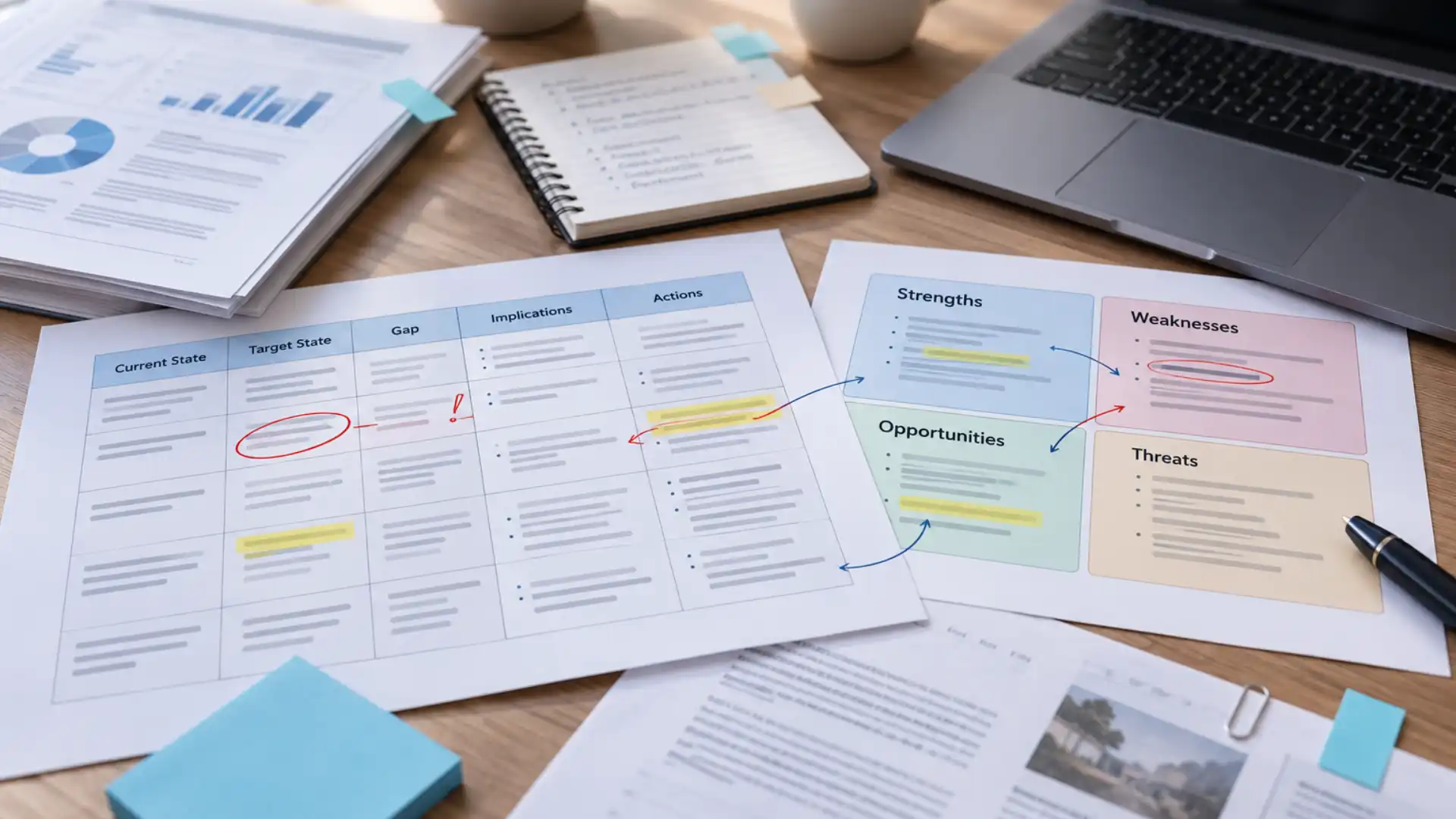

A spreadsheet full of queued topics feels like a plan — but it can't tell you why those twelve topics and not another twelve, or whether any of them will matter in three months. Here's the actual difference, and the framework that tells you which one you're running.
What "Content Strategy" Actually Means Versus What Most Teams Build
Ask most marketers to define content strategy and you'll get some version of "a plan for what content to create." That's not wrong, but it's the same as defining a business plan as "a list of things the company will sell." It describes an artifact, not a mechanism.
A working definition looks more like this: content strategy is the documented set of decisions that connects who you're trying to reach, what they need at each stage of deciding to work with you, what you'll publish to meet that need, where it will live, and how you'll know whether it worked well enough to keep doing. The word doing the heavy lifting there is "connects." A calendar full of good topics with no stated link back to a business goal isn't a strategy — it's a production schedule that happens to look organized.
The distinction isn't academic. A production schedule can absolutely produce good individual articles. What it can't do is tell you, six months in, whether the whole effort is working — because nothing in it was set up to be measured against anything in particular.
Why Most "Strategies" Are Just Production Schedules
Walk into most marketing teams and ask why a specific article exists, and the honest answer is usually "the keyword tool flagged it" or "a competitor had one." That's not a strategy failure exactly — it's evidence that no strategy was actually running underneath the calendar. A handful of symptoms tend to show up together in these teams:
- Topics get chosen by search volume or competitor presence, with no stated connection to a specific business outcome
- Nobody on the team can say which funnel stage a given piece is supposed to serve
- Planning restarts from a blank page every quarter, because nothing from the last cycle was recorded as a lesson
- Underperforming content themes never get killed — they just get published less often, quietly, without anyone deciding to stop
- The only metric anyone checks is traffic, even when traffic was never the actual goal
None of these symptoms are visible in the spreadsheet itself. The calendar looks fine. The problem lives in what's missing around it: no stated goal per piece, no review cadence, no criteria for cutting a theme loose. That absence is what separates a strategy from a schedule, and it's invisible until someone asks a question the spreadsheet can't answer.
What a Real Content Strategy Looks Like in Practice
Priya runs marketing at a twelve-person B2B startup selling workflow software to operations teams. In her first week on the job, she doesn't touch the content calendar. She pulls the last year of published articles and sorts them by which of three buyer segments they were actually written for — a step nobody had done before, because the topics had never been assigned a segment in the first place. She finds that most of the content had been written for a broad "operations leaders" audience that didn't map cleanly to any of the three groups the sales team actually closes deals with.
By month one, every new topic has to pass a simple test before it gets greenlit: which segment is this for, which stage of their decision is it meant to move, and what would tell us it worked. Topics that can't answer those three questions don't get written, regardless of how attractive the keyword volume looks. This is a slower process than pulling ideas from a tool, and the team publishes fewer pieces in month one than they did the month before.
By month three, that slowdown pays off. Priya has actual data tied to actual segments — not just traffic, but which content clusters showed up in the research history of deals that closed. Two of the three segments are producing content that correlates with pipeline; the third isn't, and she reallocates that budget into deeper coverage of the two that are working instead of spreading effort evenly across all three out of habit. Nobody had made that reallocation decision before, because nobody had the data structured in a way that made it visible. This is what a functioning strategy produces that a calendar never will: not just content, but a defensible reason to stop making some of it.
"But We Already Have a Content Calendar — Isn't That a Strategy?"
This objection is fair, and the calendar isn't useless. A well-run editorial calendar keeps a team accountable to a publishing cadence, coordinates across writers, and prevents the kind of chaos where nothing ships on time. That's real operational value, and no framework should replace it.
But a calendar has three specific limits that a strategy is built to cover.
It Tells You When, Not Why
A calendar tells you when something will be published, not why it exists — it's a scheduling tool, not a decision record.
It Has No Kill Switch
A calendar has no built-in mechanism for killing a theme that isn't working; things stay on the list because they're habit, not because anyone re-evaluated them.
It Lives in One Person's Head
And most costly over time, a calendar's logic usually lives in one person's head rather than in the system itself — when that person leaves, the reasoning behind six months of topic choices leaves with them, and the next person starts from a blank page even though the calendar file is still sitting right there.
A calendar is where a strategy gets executed. It was never designed to be where a strategy gets decided.
How to Tell If You Actually Have a Content Strategy
The question that cuts through the calendar: could someone else on your team pick up your content plan tomorrow and know exactly why the next ten pieces exist?
If the honest answer is no, the plan is a schedule, not a strategy — and here are the four things worth checking before you assume otherwise.
Goal traceability
Every published piece should trace back to a stated business outcome, not just a traffic number. If you can't point to which goal a given article was meant to serve, it was chosen by convenience rather than decision.
Audience specificity
A real strategy names who each piece is for, not "our audience" in general. If your segments are broad enough to include almost anyone who might read the article, the targeting isn't actually doing anything.
Feedback loop
A strategy has a scheduled point where someone looks back at what was published and asks whether it worked. Without that checkpoint, even good content decisions never compound into better ones.
Kill criteria
The clearest sign of a real strategy is evidence that something got stopped on purpose. If your content list has only ever grown and never been pruned, no one has actually been making strategic calls — just adding to a pile.
If you're running a short-term campaign or a one-off launch, you don't need all four of these locked down — a tight production plan will serve you fine. But if content is meant to be an ongoing part of how the business grows, skipping this framework means you're accumulating volume without ever knowing if it's the right volume. That's also the point where it's worth looking at the broader landscape of marketing tools built to support this kind of decision-making — the right tool matters less than the framework it's plugged into, but a good one makes the framework easier to run consistently.
Frequently Asked Questions
Getting Started
If you want to check where your own program stands, start small: pick the last five pieces you published and try to answer, for each one, which segment it was for, what stage it was meant to move, and what would have told you it worked. If you can't answer for most of them, that's the actual starting point — not a full strategy rewrite, just the four questions from the framework above applied honestly to what you're already doing.
The hard part isn't writing the framework down once. It's keeping goals, audience decisions, and past performance connected across quarters, writers, and however many disconnected docs your team has accumulated — the exact kind of continuity that gets lost when the one person who remembered the reasoning moves to a different project.
That continuity is what Noumi is built to hold — connecting the goals, decisions, and results from one planning cycle to the next so the team doesn't start from zero every quarter. Try Noumi →