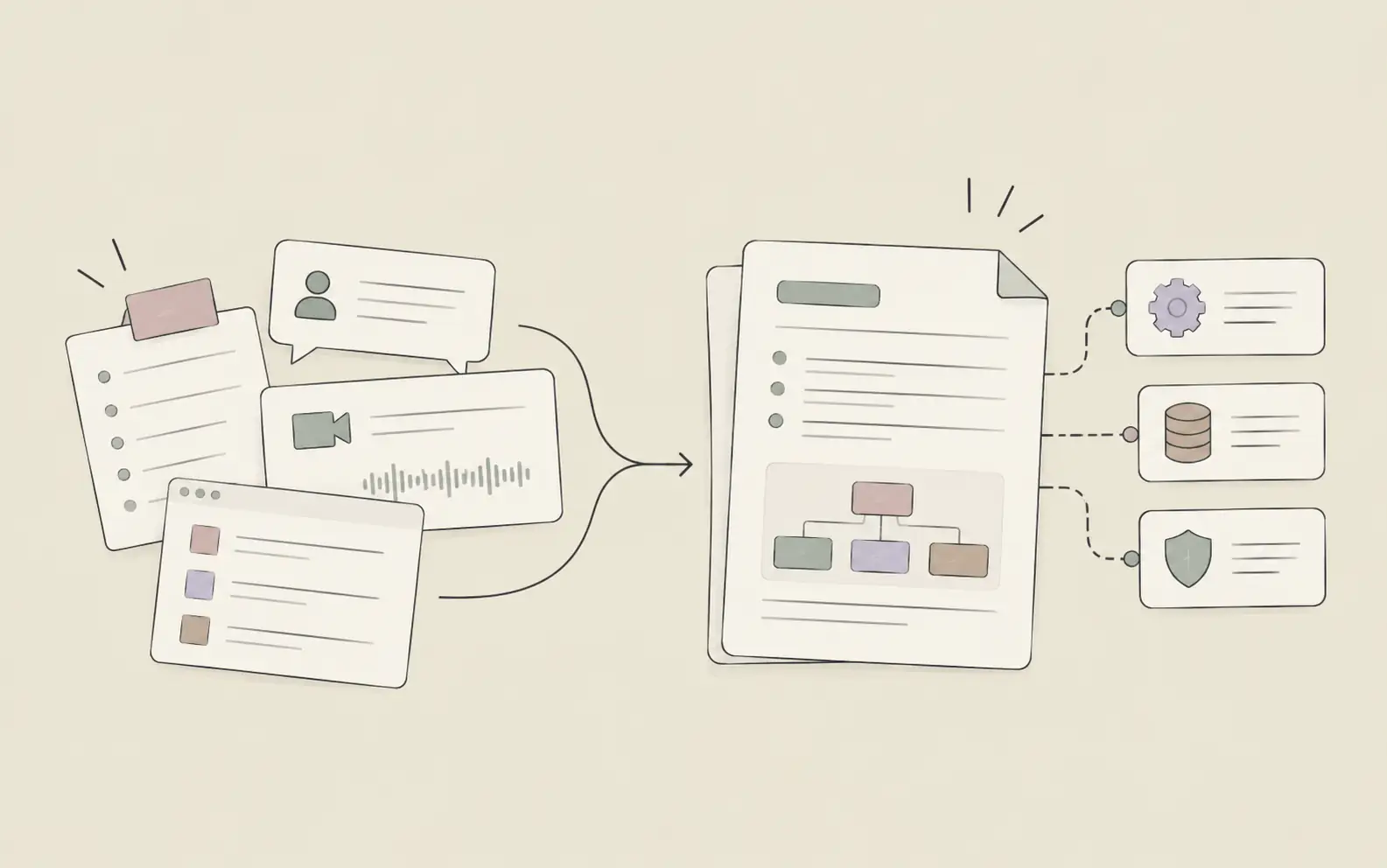

A sales assistant — a real one — doesn't just execute tasks. They know the deal history, understand which stakeholder needs careful handling, and help you walk into every call prepared. Most AI sales tools today are execution engines. This article explains what genuine AI assistance in sales actually looks like.
Why Context Is the Core Problem in Sales AI
Sales is one of the most context-intensive professional activities that exists.
Every deal has a history. Not just a list of touchpoints logged in a CRM, but a living web of context: the concerns the buyer raised in the first demo that never fully resolved, the internal champion who went quiet after a reorg, the pricing sensitivity hinted at in a side conversation. That context shapes every message you write and every call you take.
AI tools that don't carry this context can help you produce output — a follow-up email, a summary, a list of talking points. But they produce generic output, because they're starting from scratch every time. You end up editing heavily, adding back in all the nuance the AI couldn't have known. The time saved on drafting gets consumed by fixing what the AI missed.
The real problem isn't task execution — it's context retention. A genuine AI sales assistant holds everything it knows about each deal so you don't have to reconstruct it every session.
What a Good AI Sales Assistant Actually Does
Pre-call research and briefing
Before any meaningful sales conversation, preparation matters. Who are you talking to? What were the last two interactions about? What's their stated priority? What's the open question you need to resolve?
A capable AI sales assistant should be able to prepare a tight briefing for any call in your pipeline — without being asked. Not by pulling in LinkedIn bios, but by synthesizing what it already knows about the prospect from your prior interactions: what they've raised, what concerned them, what moved the conversation forward, what stalled it.
This turns 15 minutes of pre-call scrambling — scrolling notes, rereading email threads, checking CRM activity — into something that happens automatically. The briefing is there when you need it.
Tracking the state of each deal
Deals are alive. They evolve across calls, emails, and side conversations in ways that CRM fields don't fully capture. The deal that looked strong last week shifted after a comment the economic buyer made on a Friday afternoon call. That signal matters. But it's easy to lose.
A real AI sales assistant maintains a running model of each deal: what's been said, what's still open, what the buyer's mood and posture suggest about the path forward. When you return to a deal after a few days off, it has the current picture — not just the last logged activity.
This kind of longitudinal tracking reduces the cognitive overhead of managing a full pipeline. You can hold more deals without losing detail on any of them.
Drafting stakeholder communications
Sales communication is relational, not just transactional. The right email to the economic buyer is different from the right email to the champion. The right tone for a stalled deal is different from the right tone when momentum is building.
An AI sales assistant that has absorbed your communication style and the specific relationship context for each deal can produce first drafts that are genuinely close to what you'd write — because it understands the relationship, the deal history, and how you tend to navigate each situation.
You're still in the loop. But you're editing toward done, not writing from scratch.
Following up on open threads
One of the most consistent failure modes in sales is letting things go quiet. The proposal you sent that hasn't been acknowledged. The follow-up you said you'd send after checking internally. The next step you agreed to that hasn't happened.
An AI sales assistant that tracks these open threads can surface them before they become problems. Not as a CRM task notification, but as an intelligent read of what's overdue, what's slipping, and what needs your attention today.
Post-call synthesis
After an important call, the work isn't done — it's just beginning. You need to update your understanding of the deal, identify the next move, and often send a follow-up that recaps what was agreed and what happens next.
A capable AI sales assistant can synthesize a call into a clean summary, extract the key signals (objections raised, buying criteria clarified, next steps committed to), and draft the follow-up communication — all with the specific deal context already loaded. You review, adjust, and move on.
The Memory Problem in Sales AI
Here's the core reason most AI tools fall short as actual sales assistants: they don't remember.
You can have an excellent conversation with a general-purpose AI about a deal. Feed it the background, explain the stakeholder dynamics, describe the history. It will help you think through it — and do it well. But when you come back tomorrow, that conversation is gone. You start over. The context you spent five minutes explaining is no longer there.
At scale, across a full pipeline, this becomes a real cost. You're not just losing the convenience of not re-explaining things. You're losing the compounding value that comes from an AI that genuinely knows your deals the way you do.
A genuine AI sales assistant builds persistent memory. It retains what it learns about each deal, each prospect, each relationship, and uses that memory to make every subsequent interaction more precise. The longer you use it, the more useful it becomes — because it's accruing the contextual knowledge that turns general assistance into actual judgment.
Who Benefits Most from an AI Sales Assistant
Not every sales context benefits equally. The value tends to concentrate in a few situations:
Enterprise and mid-market AEs managing long-cycle deals. When a deal spans months and involves multiple stakeholders, the amount of context to track is genuinely hard to hold. An AI that maintains a running picture of each deal across the entire lifecycle reduces the risk of misreading where things stand.
Founders doing early-stage sales. Founder-led sales combines the cognitive load of selling with the cognitive load of running a company. There's no sales ops support, no SDR team prepping briefings. An AI assistant that handles the preparation and follow-up work fills a gap that's otherwise filled by nothing.
Sales managers tracking multiple reps and deals. The manager's job is to understand what's happening across a portfolio of deals and where intervention is needed. An AI that synthesizes signals across the pipeline — without the manager having to dig into each one individually — compresses a significant amount of the overhead.
Account managers handling complex renewals and expansions. Renewals and expansions require deep account knowledge. What was delivered, what wasn't, where the relationship stands, what the next growth opportunity looks like. That context compounds over time in ways that an AI with persistent memory is well-suited to hold.
What to Look For When Evaluating AI Sales Assistants
Persistent memory across sessions. If the AI doesn't retain deal and relationship context between conversations, you're the memory layer — and that defeats most of the value.
Genuine preparation, not just task execution. Can it brief you before a call without being prompted? Can it surface what's at risk in your pipeline today? Proactive assistance is where the real leverage is.
Communication that fits the relationship. Sales communication is contextual. The AI should produce drafts that match the specific relationship, not generic professional language that you have to rewrite anyway.
Integration with how you actually work. An AI sales assistant that only lives inside a dedicated app creates friction. The value compounds when the assistant has access to the context you're generating across your actual workflow — meetings, documents, messages.
Frequently Asked Questions
Getting Started
The clearest starting point is pre-call preparation. Before your next three significant calls, ask your AI assistant for a briefing on each: what the prospect has raised, what's open, what the right angle is for this conversation. Compare what comes back to what you'd have assembled manually.
If you're doing this against a context-aware assistant that knows your deal history, the briefing will be precise and immediately usable. If you're starting from a blank session each time, you'll spend five minutes re-explaining background before you get anything useful — and the gap between those two experiences is the entire value proposition.
For AEs managing complex pipelines where deal context is the constraint, not conversation volume, Try Noumi →