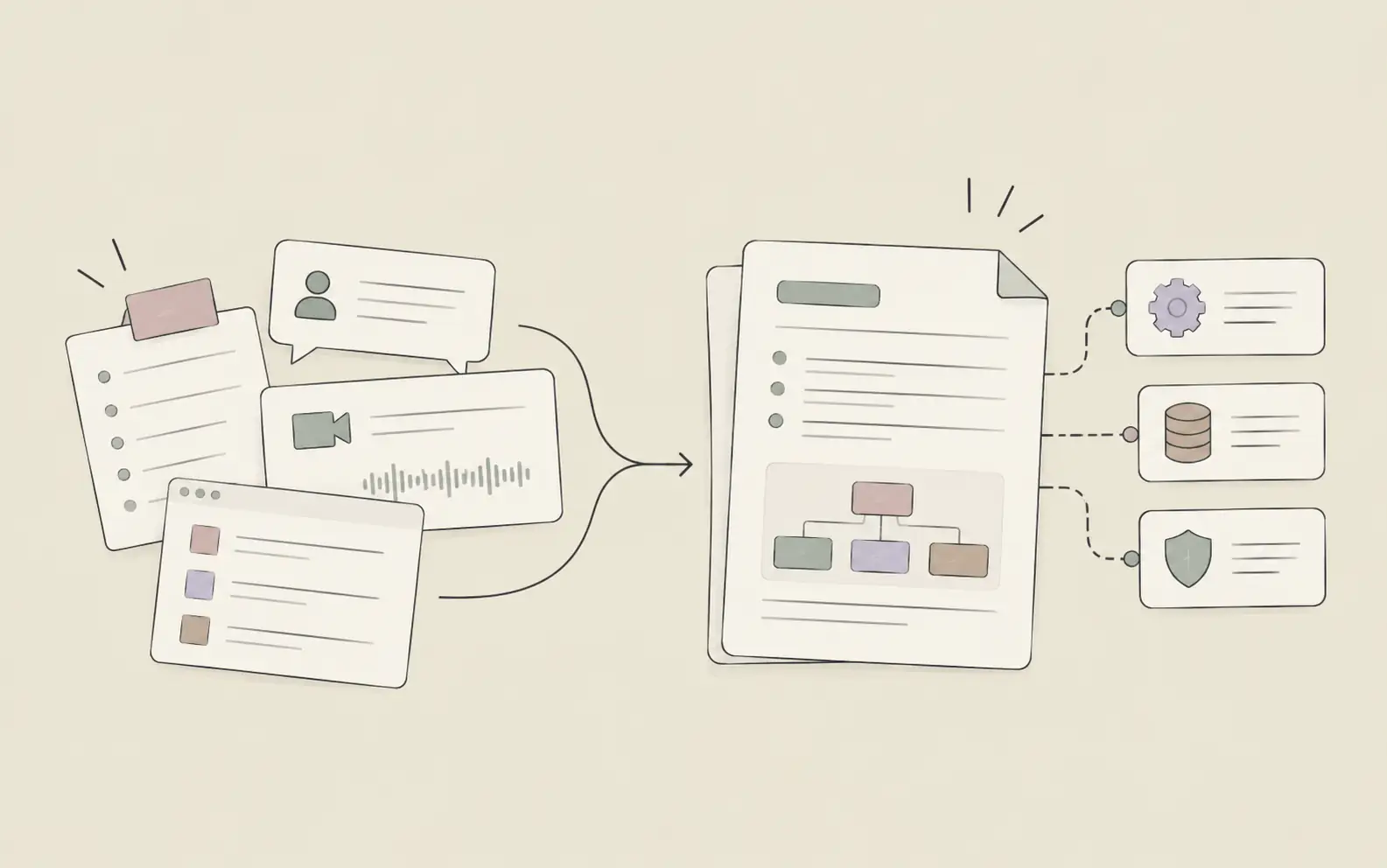

Consulting is an unusually demanding environment for AI tools. Most assistants are designed for linear workflows — one project, one context window. Consulting work is the opposite: multiple clients simultaneously, each with their own history, priorities, and stakeholders. Here's how leading consultants are using AI to work at higher capacity without sacrificing quality.
The Consulting Context Problem
A consultant working with five clients at any given time is managing five distinct worlds. Each one has its own internal vocabulary, decision history, stakeholder map, ongoing commitments, and communication norms with the engagement lead.
When you open a general-purpose AI tool and start a new conversation, none of that exists. You either re-input the context each time (slow), or you work without it (unreliable). Neither scales.
The consultants getting the most from AI aren't the ones prompting more carefully — they're the ones whose AI holds client context persistently, so every session starts where the last one left off.
If your client relationships look more like project-based freelance work than long-term engagements, this guide to the best AI tools for freelancers covers the same context problem from that angle.
What AI for Consultants Actually Looks Like in Practice
Client research and synthesis
Before entering a client engagement, before any kickoff call, before a mid-project check-in — there's research. Competitive landscape, industry dynamics, recent news about the client, analogues from other sectors.
Doing this manually takes hours per client. An AI research assistant that can pull together a structured briefing — sector context, relevant recent developments, comparable case examples — in 20–30 minutes changes the economics of how much pre-work is possible per engagement. Every client gets thorough preparation because the AI handles the initial layer, leaving the consultant to add the interpretation and judgment that actually requires expertise.
Deliverable drafting and structuring
Consultants produce a lot of structured output: slide narratives, written reports, executive summaries, implementation roadmaps, stakeholder updates. The thinking behind these takes time. The production of them — turning clear thinking into polished documents — takes additional time that doesn't have to be fully manual.
AI for consultants works best as a structured thinking partner in this phase. You articulate the argument and the key findings; the AI builds the structure, fills the connective tissue, and produces a first draft that's substantively right even if it needs editorial refinement. The result: deliverables that take 60–70% of the time they used to.
Client communication management
Consulting engagements involve a constant stream of emails, status updates, meeting follow-ups, and check-ins. An AI that knows the history of a client relationship (what's been agreed, what's been decided, what's sensitive) can draft these communications at a level of nuance that actually reflects the engagement — not generic professional language, but correspondence that fits the specific relationship.
Cross-client pattern recognition
Consultants often have relevant experience from past clients that applies to current ones, but the connection only surfaces if someone holds both contexts simultaneously. An AI assistant with memory across engagements can make this explicit — surfacing the parallel when a client presents a challenge that structurally resembles a previous engagement, giving the consultant a richer starting point than spontaneous recall alone.
The Knowledge Retention Advantage
One of the most concrete advantages of AI for consultants is managing engagement knowledge over multi-month timelines. Decisions made in month two matter in month five. Context established in the discovery phase shapes recommendations in the delivery phase. Keeping that thread continuous — across team changes, across client-side personnel changes — is genuinely hard.
An AI assistant that retains all of this across sessions creates a lightweight institutional memory for each engagement. The consultant can ask "what was our agreed framework for prioritizing initiatives?" three months after it was established and get a direct answer — not a search through email threads and slide decks.
Four Workflows Worth Setting Up This Week
These aren't hypothetical — they're the workflows consultants set up first because they pay off immediately.
Kickoff briefing package
Before entering any new engagement, have the AI produce a standard briefing: client background, recent industry news, analogues from relevant sectors, and a list of questions worth answering in the first week. Prompt template: "Research [client name] in [industry]. Summarize their competitive position, recent news, and 5 questions I should answer before the kickoff call."
Weekly client status digest
At the start of each week, have the AI compile what's outstanding, what's been agreed, and what's due for each active client. Prompt: "Based on everything you know about [client], what are the open items this week, what's overdue, and what should I prioritize Monday?" This works best with an AI that holds persistent memory — otherwise you'll be re-feeding context every time.
Deliverable first-draft protocol
For any standard output, give the AI the key findings and have it produce a structured first draft. Prompt: "Here are the 3 key findings from our discovery phase: [list]. Draft an executive summary for the CFO — 1 page, no jargon, lead with the financial implication."
Engagement close-out knowledge capture
At the end of each engagement, have the AI synthesize the key learnings. Prompt: "Summarize the [client] engagement: the initial brief, the approach we took, what worked, what we'd do differently, and any patterns worth applying to future clients in this sector." This becomes part of the knowledge base that informs future engagements.
What AI Cannot Replace in Consulting
AI for consultants is genuinely high-leverage, but it has clear limits.
Relationship judgment. Knowing when to push back on a client, how to navigate political dynamics in a steering committee, whether a recommendation is landing correctly — this is human territory. AI can prepare you for these moments; it can't execute them.
Original frameworks. The thinking that produces a genuinely novel approach to a client problem comes from the consultant. AI can help structure and develop that thinking once it exists, but it doesn't generate it.
Trust-building. Consulting relationships run on trust built through demonstrated expertise and judgment over time. The correct framing isn't "what can AI replace?" It's "what can AI handle so that more of my time goes toward the things only I can do?"
Frequently Asked Questions
Getting Started
The lowest-friction place to start is pre-meeting research and briefing. Before your next client call, ask your AI assistant to produce a brief: what's happened in their industry recently, what was discussed in the last meeting, what questions are worth raising. Compare that brief to what you'd have produced manually.
The gap in depth and thoroughness — with a fraction of the time investment — is usually enough to make the value case clearly. From there, the workflow expands naturally into deliverable drafting, communication management, and eventually the fuller knowledge-retention model that makes AI for consultants genuinely transformative over the course of a multi-month engagement.
If you're managing parallel client relationships and want an AI that holds each one's context separately without requiring re-explanation every session, Try Noumi →