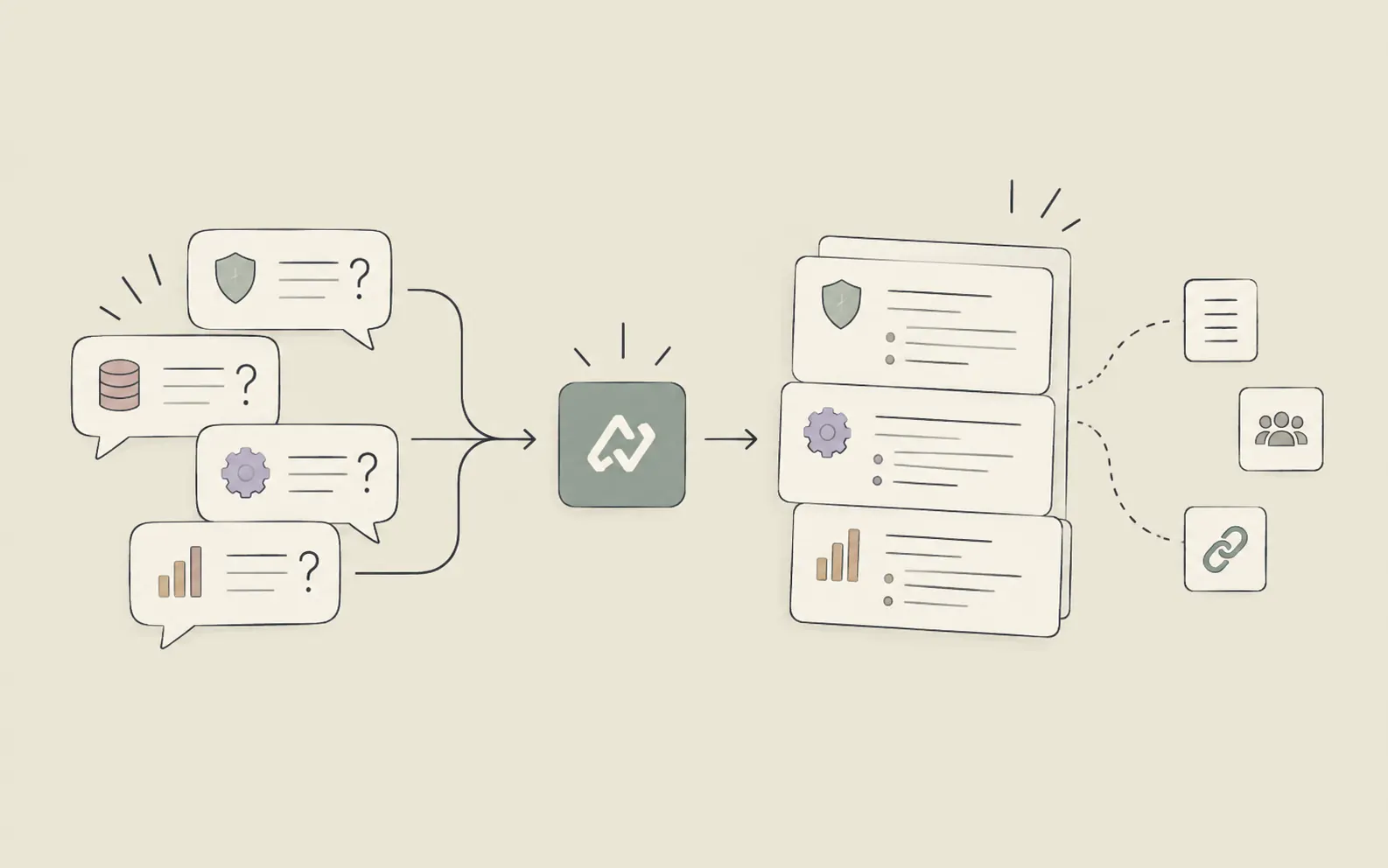

There's a ritual that knowledge workers learn quickly when they start relying on AI for real work. Before each session, you paste in context: the project brief, your notes from the last meeting, the relevant thread of decisions, the thing you told it last week that it has already forgotten. You get a good response. You close the window. Tomorrow, you do it again.
This ritual has a name, even if most people don't call it one. It's context loading. And the reason it exists — the reason it will keep existing no matter how large AI context windows become — is that the context window and long-term memory are two entirely separate things. Most people treat them as the same. That single confusion is probably costing more productivity than any other misunderstanding in how we evaluate and adopt AI tools today.
The context window governs how much an AI can work with in a single session. It says nothing about what happens when that session ends. Understanding the difference between the two is the difference between using AI well and spending your time managing it.
What an AI Context Window Actually Governs
Think of the context window as the AI's working surface for one conversation. It's the total amount of text — your messages, the AI's responses, any documents you paste in — that the model can actively hold and reason over at one time. The size is measured in tokens, which loosely correspond to word fragments (roughly 750 words per 1,000 tokens as a rule of thumb).
Everything inside the context window is, in principle, accessible to the model. Everything outside it is invisible. If you paste in a 50-page contract and the context window is large enough, the model can reason across the whole document. If the conversation runs long enough that early messages fall outside the window, those earlier exchanges are no longer in play — the model can't reference them, even if they contained information you thought it had.
What the context window explicitly does not govern: anything that persists between sessions. When you close a conversation and open a new one, the context window resets entirely. The model has no access to what happened before, not because it forgot, but because there was never a mechanism to retain it. The session ends; the working surface clears.
This is the architectural reality that all context window discussions take place around. Larger windows are genuinely useful — there are tasks where they change what's possible. But they operate entirely within the session boundary. They don't move that boundary. What does shift within that boundary is how the model distributes attention across what you've loaded — position and structure influence which parts of your input get weighted most. How a context window actually processes what you give it examines those intra-session mechanics.
The False Sense of Progress That Large Context Windows Create
The jump from 4K to 128K tokens felt meaningful. The jump from 128K to 1 million tokens felt transformative. And for certain use cases, it was. But for the majority of knowledge workers doing ongoing project work, the practical effect was more modest than the marketing suggested.
Here's what large context windows actually did: they let you paste more in. Which is real progress. But they didn't change who carries the curation burden.
Consider what ongoing professional work actually looks like:
- A three-month client engagement doesn't produce a single document you can paste. It produces dozens of calls, revisions, decisions, and implied constraints — a growing accumulation that can't be reduced to a context packet without losing the texture.
- Someone managing multiple accounts needs more than facts before each client call. They need to absorb how a relationship has evolved, which approaches generated friction, what the client cares about that they never explicitly said.
- Iterative work sessions produce corrections, refinements, and adjustments that compound over time. The AI has no memory of these. You do. Every session, you're the one synthesizing what changed.
- The same adjustment gets made three times across three sessions because nothing carried forward from the last two.
The larger the context window, the more you can theoretically paste in. But the act of curating that paste — deciding what to include, what to trim, how to represent a month of work in 2,000 words — stays entirely with you. For bounded, single-session tasks, that trade is fine. For work that accumulates over time, the window size becomes irrelevant to the core problem.
What Working Without Context Overhead Actually Looks Like
From Context Documents to a Persistent Working Model
James manages three separate product lines at a mid-sized software company. Each line has its own stakeholder set, its own rhythm of sprints and reviews, its own accumulated history of decisions that shaped what's possible now.
When he started using AI seriously, his approach was disciplined: he built a 1,200-word context document for each product line. Before every session, he'd paste the relevant one in. It worked. The AI gave useful responses. But he was spending fifteen to twenty minutes before each meaningful session just loading context, and the documents kept needing updates as each project moved forward.
By week six of switching to a tool built around persistent context — where the system retained what he was working on between sessions and updated its working model of each project as they evolved — something had quietly shifted. He could ask "what's the status on the authentication sprint?" without loading anything. The relevant project context was already there.
By month four, the change was harder to quantify but more significant. The AI's outputs were anticipating which stakeholders would push back on which framings, knowing which kinds of solutions had generated friction in previous reviews, incorporating the texture of months of iterative work into how it approached new problems. None of that was in a document he'd pasted. It had accumulated through the working relationship itself.
The context window still cleared every session. What changed was what happened between sessions — specifically, that something now happened at all. That's what compounding value looks like in practice, and it has nothing to do with window size.
"But Can't I Just Paste Everything In Each Time?"
This is the reasonable objection. If context windows are large enough, why not simply maintain a comprehensive context document and include it every session? Many knowledge workers do exactly this, and it's not a bad strategy. But it has three limits that matter at scale.
The curation problem doesn't shrink — it grows. A well-maintained context document for a three-month project might run to 3,000 words. A six-month project might need 6,000. The document needs updating after every significant session. Over time, the overhead of maintaining an accurate, useful context document becomes a part-time job in itself. You're not offloading cognitive work; you're reorganizing it.
Large context ≠ uniformly processed context. Research has consistently shown that language models don't attend equally to everything within their context window. Content in the middle of very long contexts tends to receive less attention than content at the beginning or end — a phenomenon sometimes called the "lost in the middle" problem. Pasting 100,000 tokens of project history doesn't guarantee the model will weigh all of it appropriately. For precision work, this matters.
The most valuable ongoing context isn't a document at all. A client's communication style, the framing that works with a particular stakeholder, the pattern of which approaches consistently generate friction — this kind of behavioral and relational texture doesn't compress into a document without losing what makes it useful. Understanding how that kind of model accumulates over time requires a different architectural approach than simply expanding how much you can paste.
When Context Window Size Matters — A Working Framework
The most useful question to ask about any AI tool isn't "how large is the context window?" It's whether your primary need requires holding a lot at once within a session, or carrying understanding forward across many sessions.
The diagnostic question: Does your primary need require holding a lot at once within a single session, or carrying understanding forward across many sessions? These are genuinely different requirements. A large context window solves the first. It has no bearing on the second.
Single-Session Depth
Context window size matters most when the work is bounded within a single session and involves large source materials. Contract review, synthesizing multiple research documents, analyzing a large dataset, reviewing an entire codebase in one pass — these are tasks where having a million-token window versus a 16K window meaningfully changes what's possible. If you regularly need to reason across materials that would otherwise require multiple passes, larger windows are worth prioritizing.
Cross-Session Continuity
For ongoing work — project management, client relationships, iterative content development, long-term research — context window size is mostly irrelevant to the real constraint. Even a million-token window clears when the session ends. The question that actually determines your experience is what happens to the context you build today when that session is over. For tools designed around this need, the architecture to look for is persistent memory, not window size. How context is built and retained over time across sessions is what separates tools optimized for ongoing work — comparing how different approaches stack up helps surface which architecture actually fits your workflow.
The Right Question to Ask
Before evaluating any AI tool's context window spec, it's worth asking: what is the actual structure of the work I need it to support? For product managers running ongoing roadmap work, or solutions engineers managing multi-month deal cycles, the answer almost always points to cross-session continuity as the binding constraint. The question that surfaces that constraint directly: "What happens to the context I build today when this session is over?" If the answer is "nothing — you start over next session," you've identified the actual limit, and it's not the one measured in tokens.
Frequently Asked Questions
Getting Started
Context window size is the most-cited specification in AI tool marketing and, for most knowledge workers, the least predictive of actual usefulness. It matters for a specific slice of use cases — bounded, single-session work with large source materials — and is largely beside the point for everything else.
The re-briefing ritual — pasting context every time, maintaining the summary document, re-explaining decisions already made — is a sign that the tool's architecture is mismatched to the work. The overhead doesn't go away with a bigger window. It goes away when the tool is built to carry understanding forward between sessions.
The right question is whether the AI builds understanding over time, or starts over each session. If your answer matters for how you work, Noumi was built around that question from the start. Try Noumi →